

Getting standard curtain sizes right is one of those things that sounds simple until you are standing in a store holding a tape measure and second-guessing every number.
You need to think about width, length, fullness, rod placement, fabric type, and whether the curtain is sold as a single panel or a pair.
Miss any one of these, and you end up with curtains that are too short, too flat, or covering only half the window.
This blog covers every standard size available and helps you pick the right one for your windows, whether you sew it yourself or buy it from any retail shop or online.
What are Standard Curtain Sizes?
Standard curtain sizes cover the most common window dimensions sold in retail.
Panel lengths are most commonly offered at 63, 84, 95, 108, and 120 inches.
Panel widths typically run 42 or 54 inches per panel. These dimensions are based on average residential window heights of 36 to 96 inches, with standard floor-to-ceiling heights of 8 to 9 feet.
How Curtain Sizes are Written
Curtain dimensions are written as width × length. So a curtain listed as 46” × 90” is 46 inches wide and 90 inches long.
The second number is also called the drop, which is the distance the curtain falls from the top of the heading to the hem.
Always check both numbers before buying. Width determines fullness. Drop determines where the hem lands.
Are Curtain Sizes Per Panel or Per Pair?
Many ready-made curtain packs are sold as pairs, but the size on the label may refer to each individual panel and not both combined.
A pack listed as 46” × 90” containing two panels means each panel is 46 inches wide. You get two panels at that size.
Always read the product details before assuming the listed width covers your full window
Standard Curtain Size Chart
Common ready-made curtain sizes and what they work best for:
| Curtain Width | Common Lengths / Drops | Best For |
|---|---|---|
| 46 inches | 48″, 54″, 72″, 90″ | Small windows, bedrooms, kitchens |
| 66 inches | 54″, 72″, 90″ | Standard windows, living rooms |
| 90 inches | 54″, 72″, 90″, 108″ | Large windows, wide living room windows |
| 132 inches | 90″, 108″ | Extra-wide windows, patio doors, large openings |
Standard Curtain Lengths and When to Use Each
Length is the decision that matters most. Getting it wrong by even 2 inches changes how a room reads entirely.
54-Inch Curtains
A 54-inch drop suits short windows in kitchens, bathrooms, or anywhere you want the curtain to finish near the sill.
It keeps things neat and practical. Not a floor-length option, so do not try to make it one.
63-Inch Curtains
A 63-inch panel lands just below the window sill. It works well in smaller rooms or where floor-length curtains are not practical.
Good for windows above counters or where furniture sits directly underneath the frame.
84-Inch Curtains
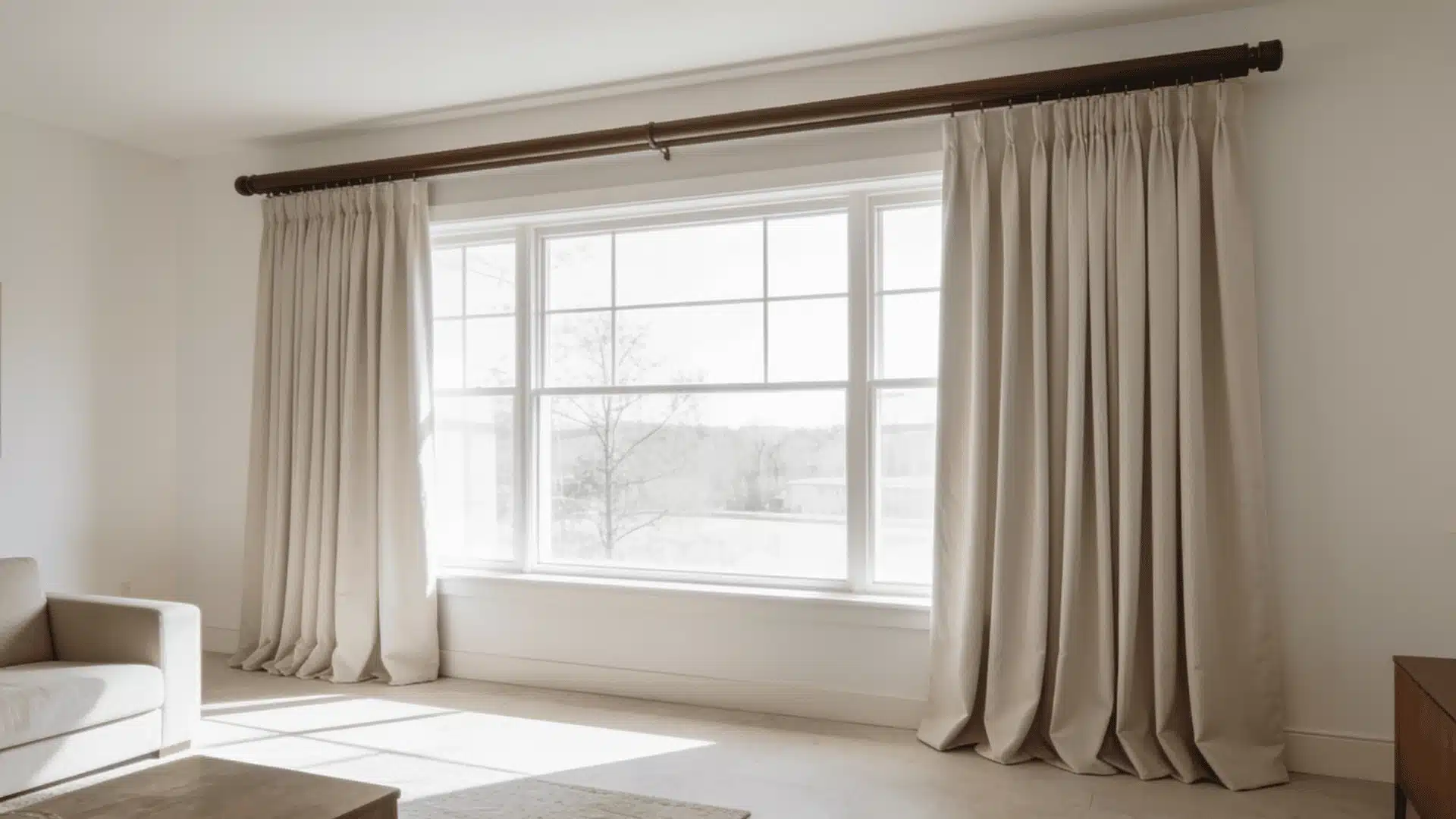
The 84-inch panel is the most widely sold length. It suits standard 8-foot ceilings when the rod sits roughly 4 to 6 inches above the window frame.
At this placement, the panel grazes or just touches the floor, which is the most common installation style in most homes.
This length does not work well if your ceilings are higher than 8.5 feet.
The gap between the rod and the ceiling becomes noticeable, and the room feels cut off.
90-Inch Curtains
A 90-inch drop works well when the rod is mounted higher above the window frame, at 8 to 10 inches rather than the standard 4 to 6.
Useful for creating the illusion of taller walls without stepping up to a longer panel. Also a practical fit for rooms with slightly higher-than-standard ceilings.
96-Inch Curtains
The 96-inch length suits taller rooms and gives a more elongated, intentional look. It works on 9-foot ceilings with the rod placed 6 to 8 inches above the frame.
This length tends to read as considered rather than default, which is a small upgrade that changes how a room feels.
108-Inch Curtains
A 108-inch panel is the right call for high ceilings, dramatic floor-length styling, or tall windows.
On 10-foot ceilings with the rod at standard height, it lands cleanly at the floor. It also allows for a slight pool if the rod sits lower.
A color that reads grounded in one length can float off the wall in another, and this length tends to anchor a room well.
120-Inch Curtains
The 120-inch panel suits very tall ceilings, luxury interiors, and spaces where a custom-looking finish matters. It works for deliberate pooling, with 3 to 6 inches of fabric resting on the floor.
More formal in feel. Harder to keep clean in high-traffic rooms, so think carefully before committing.
Quick Curtain Size Formula
Three rules to get sizing right before you buy:
- For width: Measure the curtain pole or track, then multiply by 1.5 to 2 for standard fullness. For shears, use 2 to 2.5 times the track width.
- For length: Measure from the rod, ring, track, or heading point down to where you want the curtain to finish, whether that is the sill, floor, or pool.
- For a designer look: Mount the rod higher and wider than the window frame, then choose floor-length curtains. This makes the window appear larger and the ceiling taller without any structural change.
Curtain Length Chart According to Styles
The length you choose does more than cover a window. It sets the tone of the whole room.
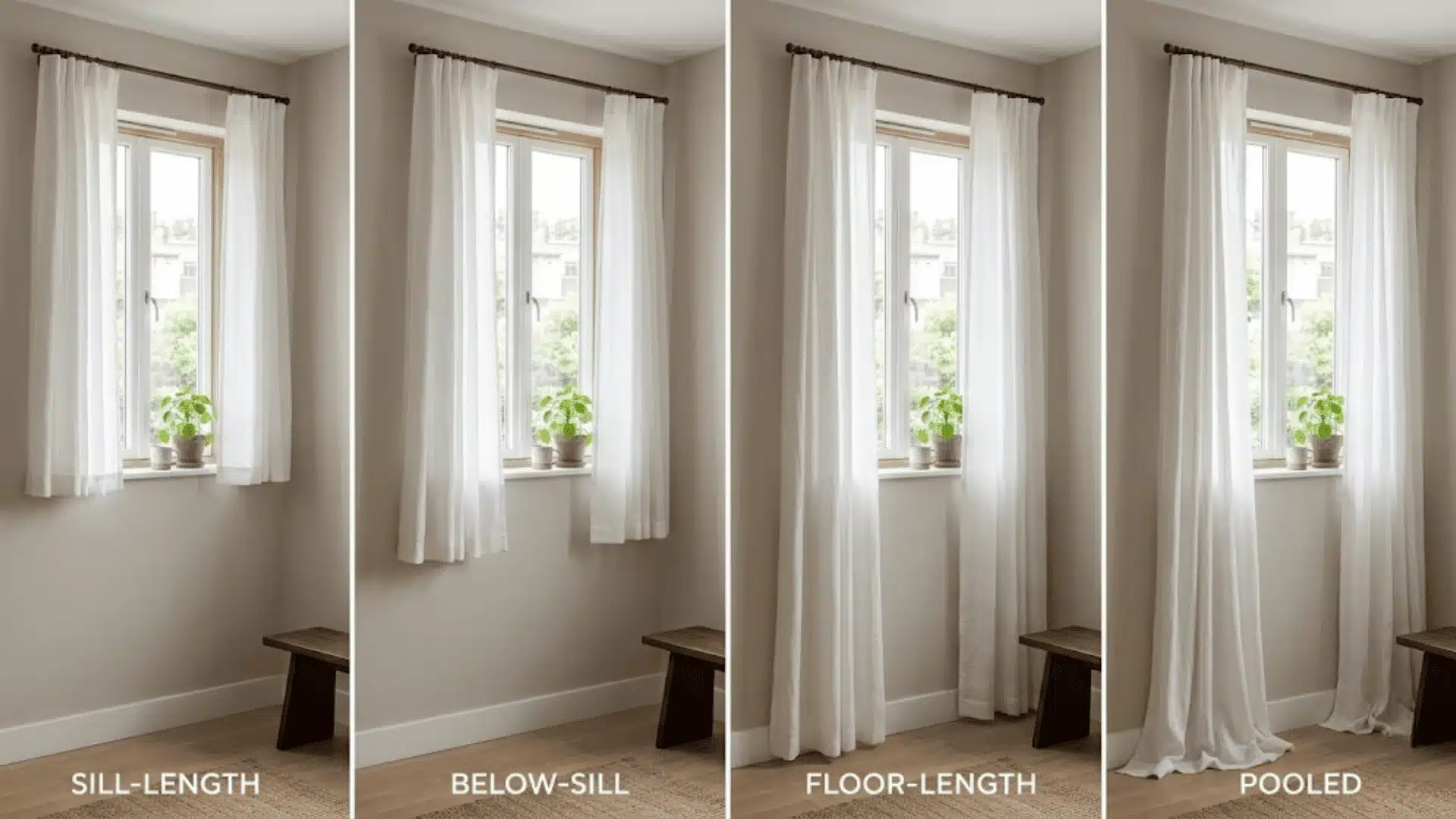
Here is a breakdown of the four main curtain length styles and when each one works best.
Apron Length
Apron length curtains fall just below the window sill, usually 4 to 6 inches past the frame.
This style works well in kitchens, bathrooms, and rooms where furniture sits directly under the window.
It keeps the look tidy and practical. A good choice where floor-length curtains would get in the way.
Ideal Rooms: Kitchen, bathroom, laundry room, home office with under-window storage.
Standard Length: 54 inches to 63 inches, depending on the windowsill height.
Trouser Length
Trouser-length curtains sit about half an inch above the floor. This is the cleanest, most versatile finish for most rooms.
The hem clears the floor completely, making curtains easier to open, close, and keep clean.
Ideal Rooms: Living room, bedroom, dining room, hallway, home office.
Standard Length: 84 inches, 95 inches, or 108 inches depending on ceiling height and rod placement.
Floor Length
Floor-length curtains touch the floor with no gap and no pool.
The hem lands right at floor level, giving a neat and finished look. This is the most popular style for modern interiors.
It works across most room types and ceiling heights.
To get this right, measure carefully from the rod to the floor and subtract half an inch for clearance.
Ideal Rooms: Living room, master bedroom, open-plan spaces, dining room.
Standard Length: 84 inches for 8-foot ceilings, 95 inches for 9-foot ceilings, 108 inches for 10-foot ceilings.
Puddle Length
Puddle-length curtains extend 3 to 6 inches beyond the floor.
This style suits formal rooms and looks best with heavier fabrics like velvet or linen. It collects dust faster and needs more frequent cleaning.
Ideal Rooms: Formal dining room, primary bedroom, sitting room, drawing room.
Standard Length: 108 inches to 120 inches, with 3 to 6 inches of extra fabric resting on the floor.
How to Measure Your Windows Correctly for Curtains?
Measuring your windows correctly is the step most people skip or rush. A wrong measurement by even a couple of inches leads to curtains that look off.
You do not need special tools. A metal tape measure, a pencil, and a notepad are all you need. Measure twice before you buy anything.
Measure the Rod Span, Not the Window Frame
This is where most sizing mistakes begin. You measure the window frame width, say, 36 inches, and buy curtains to match.
But your rod should extend 3 to 6 inches past the frame on each side, making the actual span 42 to 48 inches.
Curtains hung only over the glass block light, looking cramped. Extending the rod visually widens the window.
For width, measure the full rod span. For length, measure from the bottom of the curtain ring or rod pocket to where you want the hem to fall, whether that’s the sill, floor, or pool.
Write Down Three Numbers
Before buying anything, record these three measurements:
- Rod span (window frame width + 6 to 12 inches for returns)
- Ceiling-to-floor height
- Distance from floor to where you plan to hang the rod
These three numbers tell you exactly which standard size fits or if you need custom.
Curtain Sizes for Common Window Types
Standard Single Windows (30 to 48 Inches Wide)
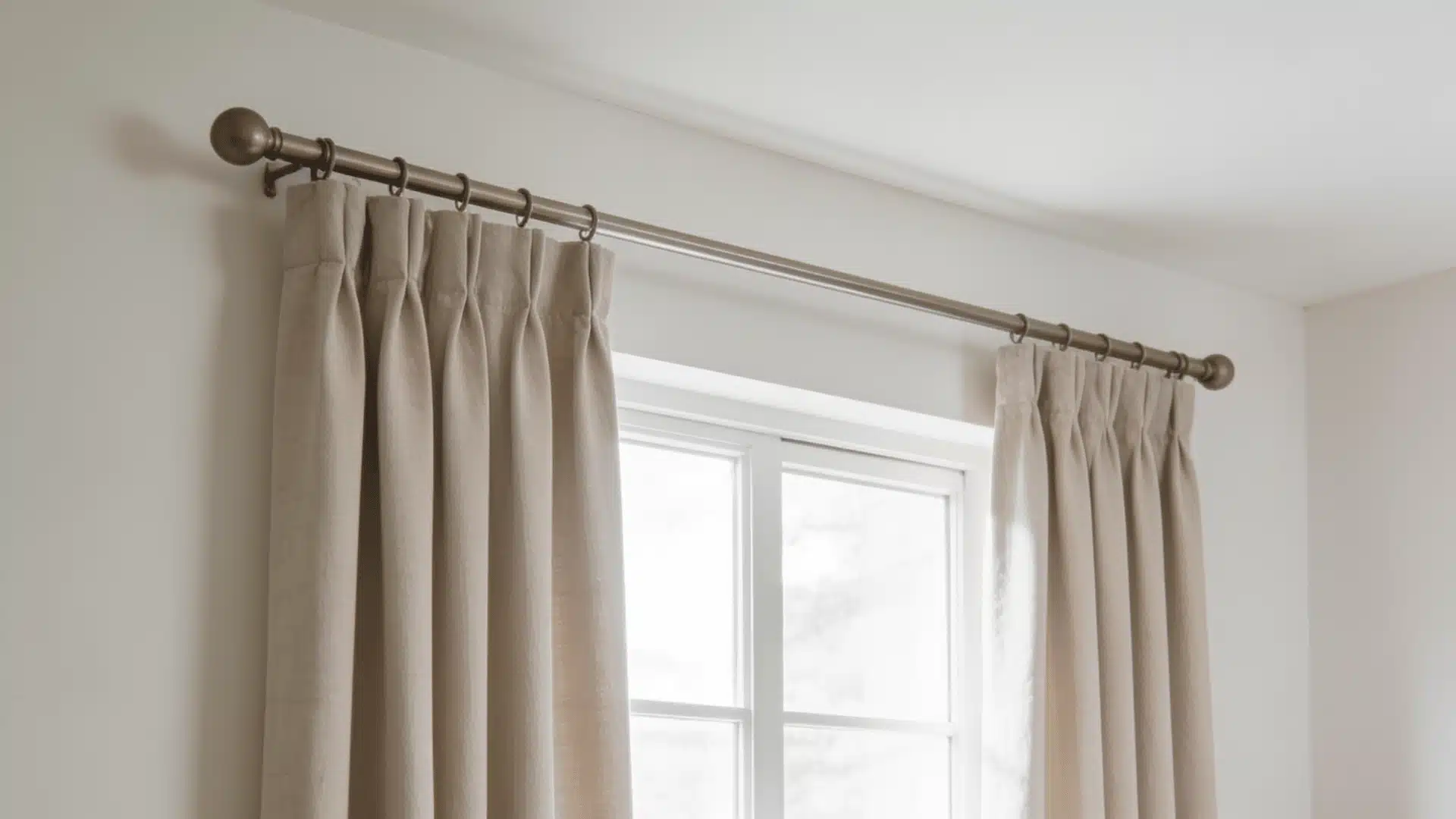
Two panels of 42 or 54 inches each. Length based on ceiling height and rod placement. This is the most straightforward scenario and where off-the-shelf sizing works consistently.
Sliding Glass Doors (72 to 96 Inches Wide)
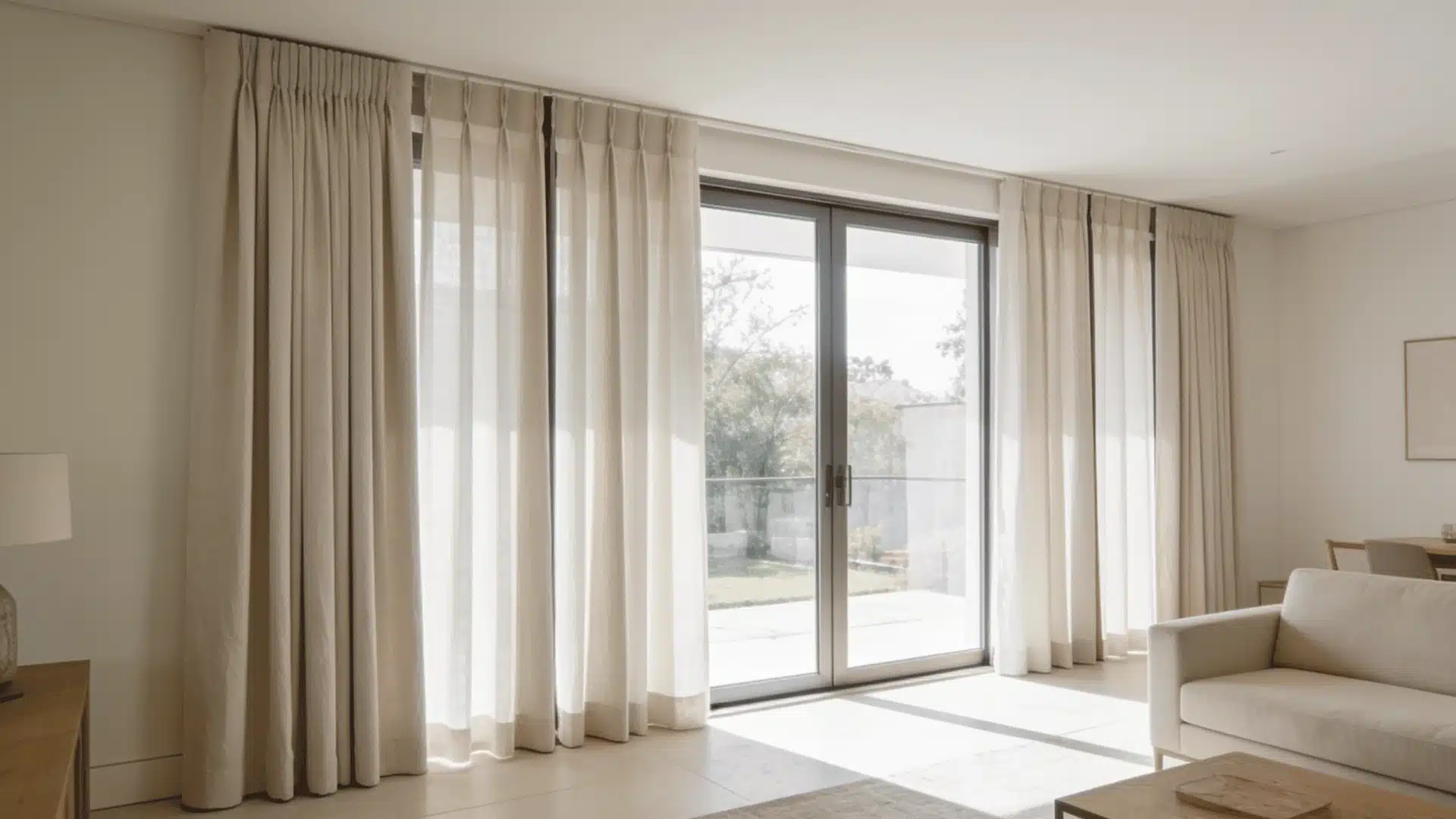
Sliding doors need coverage across the full span plus return space.
Two 54-inch panels at minimum, but for proper fullness and full coverage when closed, three or four panels work better.
Length is almost always 84 or 96 inches for standard 8-foot doors.
Bay Windows
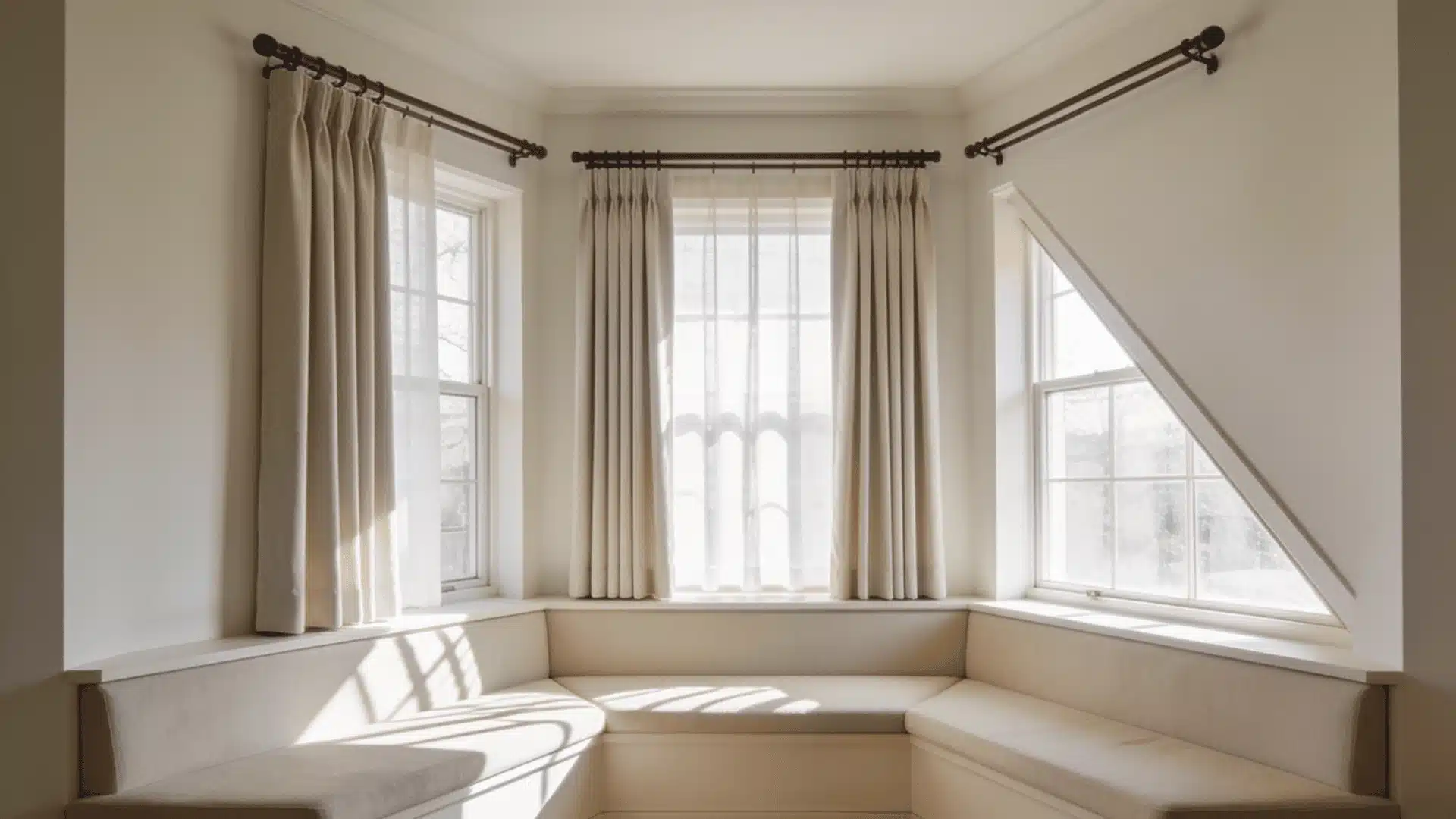
Bay windows are three-panel configurations, typically with a center section of 36 to 48 inches and two angled side sections of 24 to 36 inches each.
Each section needs its own rod and panel set. Trying to cover a bay window with one continuous curtain rod looks awkward and creates coverage gaps at the angles.
Tall or Arched Windows

These almost always require custom lengths or at least custom hemming. The arched section above the frame is typically left uncovered, with curtains mounted to frame the lower rectangular section only.
Conclusion
Standard curtain sizes cover most windows in most homes.
The key is matching length to ceiling height, rod position, and window width rather than buying the first panel that looks close.
Get your three measurements right (rod span, ceiling-to-floor, and rod height), apply the 1.5 to 2.5x fullness rule, and off-the-shelf sizing works reliably.
If your windows fall outside standard proportions, hemming a longer panel is always cleaner than living with a length that almost fits.
Frequently Asked Questions (FAQs)
1. What is the Most Common Curtain Length for an 8-Foot Ceiling?
84 inches. Mounted 4 to 6 inches above the frame, it reaches the floor cleanly.
2. How Wide Should Curtains Be for a 60-Inch Window?
Two 54-inch panels give 108 inches total right in the 1.5 to 2.5x fullness range.
3. What Does “Curtain Width per Panel” Mean vs. Per Pair?
Per panel = one piece. Per pair = both combined. US listings are per panel; UK often per pair.
4. Can You Use 84-Inch Curtains in a Room with 9-Foot Ceilings?
Yes, but they’ll float 6 to 8 inches above the floor. Use 95 inches for a floor-length look.