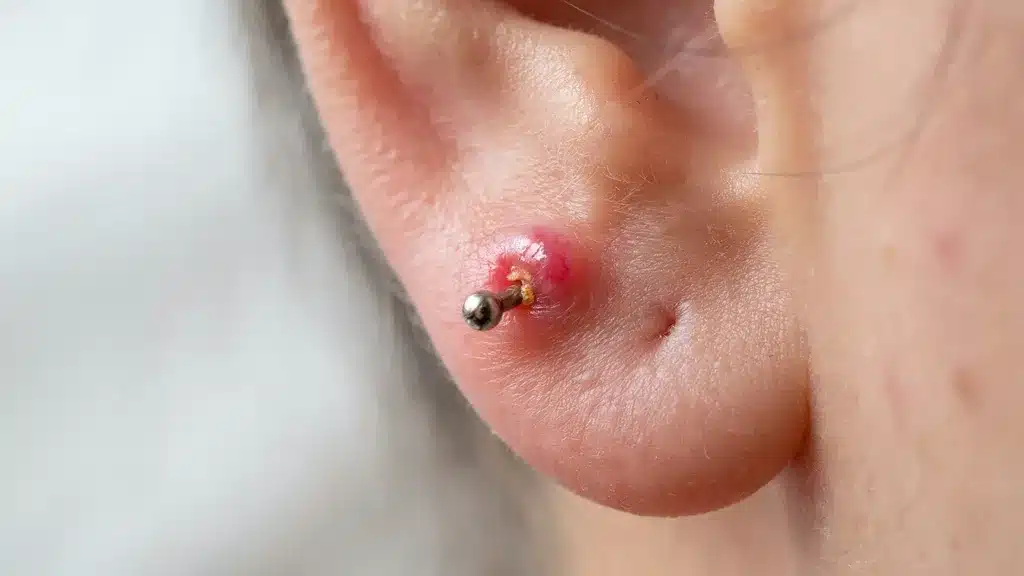

A piercing bump is a small, raised lump that forms next to a piercing site, and it appears within a few weeks of getting pierced.
Piercing bumps clear up with consistent at-home care, but the wrong treatment can make them worse.
To get rid of a piercing bump, clean the area twice daily with sterile saline solution, avoid touching or rotating the jewelry, and leave the piercing alone to heal.
The Fastest Safe Way to Reduce a Piercing Bump
At-home saline treatment works well for irritation bumps on most piercing types, like the nostril, helix, tragus, lobe, and navel piercings included.
The bump should have appeared within the first few months of getting pierced.
Older bumps respond more slowly.
Your jewelry must be made of implant-grade titanium, implant-grade steel, or solid 14k gold. Anything of lower quality can trigger a reaction.
You also need to keep your hands away from the site and avoid touching it.
And there should be no spreading redness, fever, or thick discharge, as those point to infection, not irritation.
Is a Piercing Bump Reversible?
Yes, for irritation bumps.
When caught early and treated correctly, irritation bumps resolve fully within 4 to 8 weeks without leaving any lasting mark.
Keloids are not reversible at home.
Once formed, they require dermatological treatment, such as corticosteroid injections, laser therapy, or surgical removal.
How to Get Rid of a Piercing Bump?
Piercing bumps do not disappear overnight, but they do respond to the right aftercare.
The measures below cover what to do to clear an irritation bump as quickly as possible, and if you skip one step, the others work more slowly.
1. Clean With Sterile Saline Solution
Spray sterile saline wound wash (0.9% sodium chloride) directly onto the bump and surrounding skin.
Hold the can 2 to 3 inches away from the site.
Let it sit for 30 seconds and pat dry with a clean piece of gauze or a fresh paper towel. Do this twice daily, in the morning and at night.
2. Stop Touching the Jewelry
Put your hands down. Every time you touch, twist, or rotate the jewelry, you damage the tissue trying to heal around the piercing channel.
Rotating jewelry during healing causes harm, not help.
Between cleaning sessions, leave the piercing completely alone.
3. Check Your Jewelry Material and Fit
Look at what is sitting in your piercing.
If it is not implant-grade titanium (ASTM F136), implant-grade steel (ASTM F138), or solid 14k or 18k gold, the material itself may be causing the bump.
Low-quality metals contain nickel, a common skin irritant.
Visit your piercer and ask them to check the fit too.
A bar that is too short puts direct pressure on the piercing and stops it from healing.
4. Remove All Sources of Irritation
Think about what touches or presses against the piercing every day.
Sleeping on it, wearing over-ear headphones against a helix piercing, or bumping it with a hairbrush all lead to slow healing.
Switch to sleeping on the opposite side. Use a travel pillow with a hole in the center if needed.
5. Add a Warm Saline Compress if the Bump Persists
If two weeks of twice-daily saline spray have not moved the bump, add a warm compress once daily.
Soak a clean piece of gauze in warm, not hot, saline solution.
Press it gently against the bump for 3 to 5 minutes. This increases blood flow to the area and helps reduce fluid buildup inside the bump.
Keep up your spray routine alongside this step.
6. Give it Time and Look for Changes
Check the bump every week, not every day. It should be visibly smaller within 2 to 3 weeks of consistent care.
If it is flattening and less tender, you are doing it right.
If it is hardening, growing beyond the piercing hole, or not changing after correct treatment, go back to your piercer.
What You Should Never do (Even If You’re Desperate for Results)
Piercing bumps get worse because of what people do to them, not what they leave alone.
- Do not pop, squeeze, or pierce the bump yourself.
- Do not use rubbing alcohol or hydrogen peroxide, both of which destroy healthy tissue.
- Do not apply tea tree oil directly, as it can cause contact dermatitis on healing skin.
- Do not rotate or twist the jewelry, as this tears the healing tissue inside the piercing channel.
- Do not swap the jewelry out early.
- Do not apply Neosporin, coconut oil, or any thick ointment.
- Do not over-clean more than twice a day, as it strips the skin and increases irritation.
This article is for informational purposes only and does not replace professional medical advice. If your piercing shows signs of infection or the bump is not improving, consult a licensed dermatologist or your healthcare provider.
Ending Note!
Piercing bumps are irritation bumps, and irritation bumps are fixable.
Twice-daily sterile saline cleaning, hands-off healing, and jewelry that fits correctly will clear the majority of them within 4 to 8 weeks.
If the bump is growing, hardening, or showing signs of infection, that is the point to stop self-treating and get professional help.
Now you know what to do: get into a good aftercare and see how it heals.
People Also Ask
1. Can I Pop a Piercing Bump?
No. Squeezing or puncturing a piercing bump pushes bacteria deeper into the tissue, increases the risk of infection, and can cause scarring.
2. Does Tea Tree Oil Get Rid of Piercing Bumps?
Tea tree oil is too harsh for direct use on a healing piercing. Stick to sterile saline solution.
3. How Do I Know if My Piercing Bump is a Keloid?
A keloid grows beyond the original piercing hole, feels firm or rubbery, and does not shrink with saline treatment over several weeks.