How to Buy a Better Furnace — Fast

house

The last thing you want just before the winter holidays is for your heating to go out — but of course, that’s exactly what happened. Now, you need to move fast to replace your furnace fast, to keep your home warm and toasty during the most wonderful time of year. Of course, make sure to view website options of different furnace repair companies like Call The General before deciding you need a replacement – the issue could be fixable!

However, acting quickly should not be synonymous with acting rashly. Your furnace is a major component of your home, which means you need to be careful to select the system that suits you best — or else you’ll be rushing to replace your furnace again next winter.

Fuel Type

When most people use the word “furnace,” they are talking about a gas heater, which burns natural gas to heat the air that travels around their home. Gas furnaces are some of the most efficient central heating tools, especially because natural gas burns cleaner than coal and oil, which power most electricity plants across the United States. Plus, natural gas tends to be exceedingly affordable, making heating your home during the winter less of a budget-buster.

Still, you shouldn’t buy a gas furnace if you don’t already have a natural gas heating system in your home. In fact, you might not have a furnace at all. Many older homes use hot-water systems, which have radiators in each room to supply heat. If you live in a warmer climate, your home might have a less robust heating system, like a heat pump, which likely runs on electricity. You should do some research into what kind of fuel your heating system runs on, so you don’t waste time researching the wrong type of furnace.

Size

Size is an incredibly important factor in any heating and cooling equipment — and contrary to what you might expect, bigger isn’t always better. Obviously, a furnace that is too small for your home might not be able to keep your rooms adequately warm; on the other hand, a furnace that is too large will frequently cycle on and off, wasting fuel and energy and perhaps burning out sooner than expected.

If you know the size of your old furnace, and if you haven’t added any rooms onto your home, you can buy a system of identical size. Otherwise, it will be worth your time to bring a contractor onto your property to measure your property and calculate the necessary size of your furnace, in BTUs or tons. You shouldn’t trust a measurement given to you over the phone or by anyone who hasn’t visited your home; this calculation is complex and takes into consideration your square footage, the efficiency of doors and windows, insulation levels and more. It is best to be safe and pay more now for a truly expert opinion than waste your time and money on a unit that doesn’t suit your needs.

Features

It might be difficult for you to believe that furnaces come with different features. What, is your furnace going to have four-wheel drive and be able to run Microsoft Office? Though your furnace definitely won’t come with those kind of bells and whistles, there are differences in how furnaces are built, and choosing the right features will make your life easier.

Here are a few top features to seek out in natural gas furnaces, specifically:

· Two-stage valves. Valves control the flow of fuel, and having two-stage valves provides you more minute control over the air temperature in your home. At first, two-stage valves turn on high to provide fast heating, but the power slowly tapers to ensure rooms don’t get overheated.

· Sealed combustion. One of natural gas’s byproducts when burned is carbon monoxide, which is a colorless, odorless gas that is exceedingly toxic to humans and pets. Sealed combustion chambers ensure that no CO leaks into your home, keeping everyone safe.

· High-end filters. You should be replacing your HVAC’s air HEPA filters every few months, but you might also search for a furnace that comes with an electrostatic filter to trap even more particulates and keep your air clean.

Warranty

Finally, the last consideration you should make when buying a furnace is its warranty. If you have an older home, you should already have a home warranty in place to keep your entire HVAC system in good working order. If you don’t currently have one, you might want to check out providers in your area. Companies like First American operate in states across the country so, whether you live in Florida, Kentucky, or elsewhere, you’ll have the peace of mind that, should anything go wrong, local contractors can be called out to diagnose and address the problem. If you’d like to check for availability in your area, click for more info.  However, a new furnace should also come with a factory and/or retailer warranty covering parts and service for at least a few years, maybe more on more delicate components like heat exchangers. You might consider acquiring an extended warranty from a third-party warranty reseller, which offers lower rates for the same coverage.

You can get a furnace fast and cheap — but that doesn’t mean you can get the right furnace for your home without doing any research. Knowing what kind of furnace you want goes a long way toward ensuring you won’t have a similar catastrophe before the holidays next year, or even the year after that.

4 Most Important Issues to Address in a Fixer-Upper

Buying a fixer-upper home is something that you do with the knowledge that you’re taking on a big project. You could be facing a huge challenge, with many different problems to tackle before you’re able to either live in the property or sell it on. Sometimes, it can be difficult to know where to start, but there are always certain things that you will probably want to tackle before you deal with anything else. If you’re finding it a challenge to find a fixer upper, you need to get your priorities right.The Electrics

Bad electrics in a property could be a massive problem. Firstly, they could be dangerous if you don’t fix any big problems. Electrics that are in poor condition could lead to fire, and then you might not have a property to fix up any longer. Even worse, it could put your life and the life of others in danger too. Apart from the dangerous aspect of it, poor electrics will cause a range of other problems. If everything is old, you might find that you can barely have two lights on at once without threatening to overload the electrics.

Image from PexelsPexels License

The Plumbing

As well as looking at the electrics, you will probably want to consider the plumbing. Older plumbing is often inefficient and it can be very noisy too. If you want to avoid problems like poor water pressure or clanking and groaning whenever you run water, you need to take a close look at the plumbing in your property. It’s also important to fix any problems, such as leaks or drips, or perhaps exposed pipes that need to be insulated. A good plumber can help you with any plumbing issues that you might come across.

The Roof

The roof of your property helps to protect the rest of it. Without the roof, you will struggle to keep the property warm and dry. With a fixer-upper, you will often find that not only do you need to make some repairs to the roof but you may even need to replace it completely. If you consult a roofing guide with advice on roofing repairs, you can work out whether a replacement might be necessary. A roof can last anywhere between 10 and 25 years, or sometimes longer, depending on the material used and the type of roof.

Any Structural Issues

Any structural problems that the property might have need to be addressed right away. In addition to the roof, you will also want to take a good look at the foundations to check that they are in good condition. You should watch out for any indications that there could be major structural issues, such as cracks in the walls or foundations. Ideally, these will be things that you check before buying the property so that you know if it’s worth investing your money on making the repairs.

When you get that fixer-upper, make sure you have the most important issues taken care of before doing anything else.

3 Common Natural Threats to Your Home’s Safety and Stability

Nature is a powerful force and without a lot of maintenance and care, it can quickly have a serious effect on the structural stability and safety of your home. From extreme weather to tiny insects, there are countless natural threats that can affect your property’s safety and value.

Keeping on top of these potential issues can be challenging and time-consuming, which is why being aware of the warning signs is so important. To help you monitor the natural threats to your home, here are some of the most common problems you might come across.

Squirrels

Squirrels are one of the most common rodents in the world and whilst not commonly considered dangerous, they do actually pose a threat to your property. As very active and successful climbers, squirrels are excellent at getting into high spaces which can result in them accessing your attic through the eaves of your roof. Once inside, squirrels often build nests in these attic spaces and aren’t afraid to chew through your property during their time there.

Particularly important is the threat of squirrels chewing through pipes and wires. Damaged pipes can quickly lead to expensive leaks and water damage, whilst the live wires can pose a serious electrical or fire hazard.

If you begin to hear scratching, rolling or skittering in your roof, there is a high likelihood that it could be a squirrel nest. Be sure to investigate if you hear anything suspicious, particularly during the early morning, and investigate your options for getting the rodents to leave.

Woodworm

Woodworm is an incredibly common natural occurrence but few people realise exactly what it can do to your property if left unchecked. Woodworm is actually the name given to the larvae of multiple species of wood-boring beetle. These insects burrow into timber and lay their eggs within; when the larvae hatch, they chew through the wood to grow until they are ready to exit as fully grown beetles, after which they bore out of the wood and leave small exit holes as evidence.

These exit holes are the most common woodworm infestation identifier but there are actually a few different signs of woodworm that you can look out for. This is particularly important because the exit holes only become visible after the infestation has done its damage.

Stopping woodworm is important because whilst small in size, the larvae are great in number and weaken the timber that they infest and chew through. For small furniture items, this might not be a huge problem, but woodworm infestations can also destroy wooden structural supports and beams, causing serious damage to your property. With that in mind, if you suspect you have a woodworm problem, be sure to get an expert opinion to confirm your suspicions.

Plants and Trees

Plants are easily one of the most powerful forces that can damage your home. Given enough time, tree roots and wall climbing plants like ivy can disrupt property foundations as well as wall strength and stability.

The good news is that the process of tree and plant growth is fairly slow, meaning that you can usually catch the start of the problem and fix it before it gets too serious. The common fixes are simply cutting back the plants or roots and sometimes, creating a barrier to prevent the problem from happening again. However, prevention is better than cure, so be sure to keep an eye on what type of trees are near your house and what plants are growing nearby.

These three natural threats are only the tip of the iceberg when it comes to what can damage and affect your property. The most important point to remember is to stay aware of your surroundings and question anything about your home that doesn’t look quite right. The smallest issue can grow into a major problem if left for too long.

4 Ways To Avoid Expensive Plumbing Problems In The Home

Burst pipes and leaks cause a lot of damage, and then you have to deal with the cost of calling out a plumber to fix it.   In some cases, you can’t really avoid it and you will just have to accept the cost. Maintenance is part of being a homeowner, after all. But a lot of those problems could be avoided if you look after your plumbing properly. These are some of the best ways to avoid expensive plumbing problems in your home. 


Get The Plumbing Checked Regularly 

If you are trying to avoid spending money, calling out a plumber might not seem like the best idea. But if you want to avoid expensive problems in the future, you should get a regular checkup on the plumbing once every year or two at least.  Sarkinen Plumbing can help you check your plumbing and fix any problems you may have.  If you have the plumbing checked, they will be able to pick up on small leaks and cracks in the pipes that are likely to develop into worse problems later on. It’s a lot cheaper to fix them now while the problem is still small, instead of waiting until that pipe bursts and you have to deal with that. 

It’s especially important that you check for any signs of problems with your boiler because if that breaks down, it’s very expensive to fix and it can cause a lot of issues with the rest of your plumbing.  In this case, it is much wiser to invest in a new boiler model that is energy efficient, but best to browse new boiler cost before purchasing one.   It can also be very dangerous because a broken boiler may leak carbon monoxide into your home. 

Be Careful What You Put Down The Sink 

Clogged drains can lead to a lot of problems with the plumbing, and they’re usually caused by you. It’s important that you are careful about what you put down the sink because if you keep putting things down there that you shouldn’t, you will cause yourself a lot of trouble. People often make the mistake of pouring cooking fat down the sink, but it will solidify once it cools and cause a big blockage. The same goes for any waste food that ends up in there when you rinse plates, so make sure to scrape them into the bin before washing them up. 

In the shower, you need to be careful about clogging the drain with hair. Get yourself a hair catcher over the plughole so you are not blocking up the pipes. If you let it all go down the drain, it will be tough to get it all out again. 

Even if you are careful, things can still clog the drains, so it’s best to clean them out regularly. You can buy drain cleaning fluid that you pour down there and leave to soak. It should break down anything that is blocking the sink so you can wash it away. If you want a more natural solution, try using baking soda and vinegar to break things up, and then pour some boiling water down there. 

Stay On Top Of Limescale 

Limescale buildup can cause a lot of damage to your kitchen appliances and the fixtures in your bathroom, so you need to stay on top of it. If you live in a hard water area, you will have noticed spots appearing and limescale building up around the showerhead and taps. Using a citric acid based cleaner is a great solution for hard water spots because it cuts through the deposits that are left behind but it doesn’t use any harsh chemicals. If you clean off those deposits regularly, you can stop any thick limescale building up and causing damage to your fixtures, so you don’t need to keep replacing them. If you are finding it difficult to manage limescale, you should consider installing a water softener to filter out the minerals that leave the deposit behind. 

Learn To Fix Things Yourself 

No matter what you do, problems with your plumbing are going to happen sometimes. But you shouldn’t be so quick to pick up the phone and call a plumber every time something happens because there are a lot of issues that you can fix on your own. You don’t need to pay somebody to fix small problems like a leaking faucet or a drain that is a bit clogged if you just spend a bit of time learning how to do those things on your own. Just be realistic about what you can and can’t do and know when it’s time to call a plumber. If you try to tackle jobs that you aren’t qualified for, you will end up doing more damage. 

If you follow these simple tips, you can avoid most of the big plumbing issues and save yourself a lot of money. 

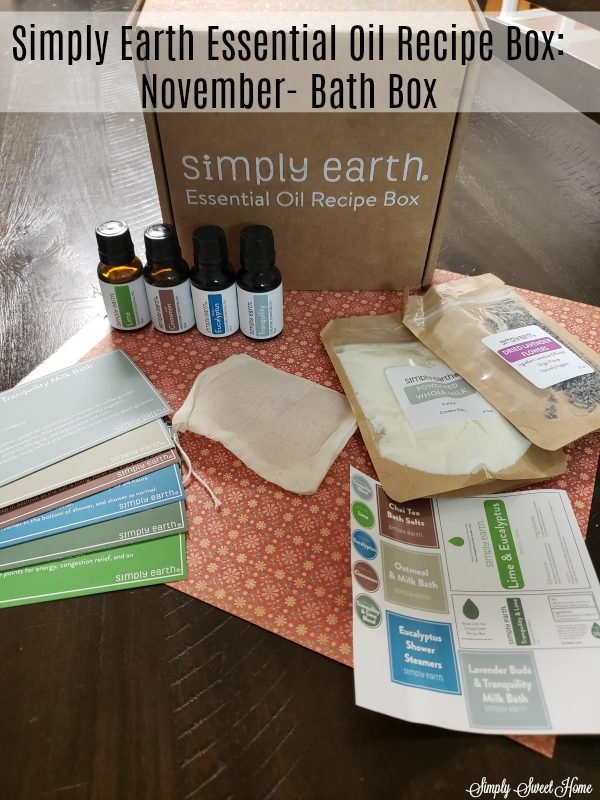
Simply Earth Essential Oil Recipe Box: November – Bath Box

Disclosure: I received free products to facilitate this post.  Affiliate links are contained herein. The opinions are my own.

Happy November! Today I have another great Simply Earth Essential Oil Recipe Box unboxing for you!  This is a monthly subscription program for essential oil lovers, and it is such a great value! The theme for this month is BATH!  With the stress of the holiday season, plus cold weather AND cold & flu season, everyone takes a take a hot bath, so this is the perfect time for the theme.

If you haven’t read my previous posts on the Essential Oil Recipe Box, here are the details:

  • Cost is just $39 / month.
  • Each box has 4 bottles of essential oil, recipe cards to help you use your oils in fun and unique ways, plus other materials you need to make the recipes.
  • Each box is specially curated with a unique theme in mind.
  • Each box is a $150 value!
  • When you subscribe you get a cool BONUS box for FREE!
  • You also get a $40 gift card for FREE when you use my referral link and coupon code:  SSHOMEFREE!

[Read more…]

7 Ideas to Create a Workspace Which Will Inspire for Writing

Writing is a true art. You may be working on a blog, news article, tech copy, novel, or even an academic paper for college. Still, each word you type will be another manifestation of art.  For help with your college essay papers, check out customessaymeister.com.

As we all know, art in any of its forms requires inspiration. Without any, it is impossible to keep the words flowing. However, where to look for incentives?

Inspiration can be found everywhere you go and in whatever you do. It is in books, in paintings, in sunrises and sunsets, and in every little thing that surrounds you.

One thing that not every aspiring writer knows is that inspiration can be drawn even from your workspace. Or better say, your perfect workspace is the one that inspires you.

If you manage to create such a space, you will be surprised by how it can affect your workflow. In this article, we are going to give you a few ideas on how to do it.

Can you say that your workspace is inspiring?

It doesn’t really matter if you are a poet, academic writer who prepares a great essay outline for any project, blogger, or just one of the millions of college students forced to write a paper during their studying process.

In any case, lack of inspiration results in a so-called writer’s block that holds you back from creating the best piece. That’s why everyone needs an inspiring workspace, and here are some of the best ideas that will help you to create one:

Choose the Right Furniture

In order to make you feel comfortable and avoid physical stress from long working hours, it is vital to equip your space with ergonomic furniture, like an office chair from Office Monster.

The first prominent feature of an effective space is a good old desk. Some authors prefer spacious and large ones, while others stick with smaller options.

Which one to choose is up to you. The only thing you have to ensure is that you feel comfortable and productive working at it.

The next vital piece of furniture is an office chair. It should be as comfortable as possible, supporting your back and encouraging proper posture to help you avoid aches.

Opt for a Standing Desk

This point is some sort of contradiction to the previous one. However, this might be just the right option for some people.

It is odd enough, but some studies suggest that standing desks can bring lots of benefits, including:

● Decreased risk of heart diseases;

● Better engagement in the process;

● Lower chances of developing musculoskeletal problems;

● Boosted life expectancy;

● Higher productivity.

These are only some of the key benefits of standing instead of sitting while writing. Therefore, standing desks could be an excellent option for those who don’t mind being on their feet for long hours.

Find a Place Isolated from Distractions

This is one of the most critical points you should keep in mind when preparing your working environment. It doesn’t really matter how cozy and inspiring the space is. If you can’t shut out all distractions, you won’t be productive.

Unfortunately, implementing this can be quite hard for some. Especially for young people who are currently obtaining education and live in dorms. However, the good news is that you don’t need to own acres of land and large properties to find a small, isolated, distraction-free corner for yourself.

Keep Windows Open

Let lots of fresh air circulate in the room.

The main reason that makes this a good tip is that fresh air and sunlight can give you a boost of energy. Besides, keeping the windows open, you rid the room of any fumes, which contributes to your overall well-being.

Surround the Room with Books

If you are an experienced writer, you should know that writing and reading are closely tied to each other. For ages, books have been the primary sources of inspiration for authors. Therefore, having a mini (or even a full scale) library right in your office can be great for productivity and motivation!

Decorate the Space with Things That You Like

Are you a fan of paintings or love Christmas lights? Any type of decoration that you like can help in making the environment even more inspiring.

Therefore, feel free to decorate the room with anything that looks good, be it motivational posters, plants, lights, flowers, etc.

Let It Reflect Your Personality

Finally, the best advice we can give you regarding arranging the writing environment is to make it more “you,” meaning to let it reflect your personality.

Every author’s office is unique. It can be small or large, dark or light, empty, or decorated with a variety of items. The only rule is to organize it the way you feel it!

Final Words

What does a perfect writing space look like? Browsing the pictures of famous authors’ workplaces, you can clearly see how different and unique each one is.

Some places are messy and stuffed with notes, books, and papers, while others look completely empty. This means that there is no answer to this question that’s right for everyone.

In brief, the environment you write in should be a reflection of your personality. It should make you tranquil and comfortable. Also, it should shut out all possible distractions.

In this article, we have collected some key ideas on how to create a place that inspires and sets you in the right mood for creating another piece of art.

Rookie Humans Fitted Crib Sheet Review

  Disclosure: I received product samples to facilitate this review. The post may contain affiliate links. The opinions are my own.

Before my son was born I shared our forest friends nursery reveal with you guys.  Unbelievably that was 2 years ago!  Even though he is almost a big two year old, Thaxton still has the same nursery theme, and we’ll be keeping it in place for the next year, if not the next two years, or longer…

Today I’m sharing a new cribsheet that we got for his room.  It is from Rookie Humans. They offer sheets that are soft and breathable; they are 100% soft cotton sateen with a 230 thread count, and they feature the most adorable scenes for your crib or toddler bed! [Read more…]

Important Questions To Ask Before Your Next House Move

Are you thinking about moving home soon?

There are all kinds of reasons as to why you might be.

A house move could give you the opportunity to make a fresh start. You can position yourself nearer to your place of work or your children’s school. And especially if your current home is getting you down, for whatever reason, you will finally have the chance to live life anew in a better property.

But before you rush into any hasty decisions, there are some important questions you need to ask yourself first. While a house move could be a good idea, it might be that you need to wait a little while longer before speaking to a realtor and packing up your boxes.

#1: Can I afford to make the move?

If you’re currently struggling with money, it might be that a house move could be beneficial to you. By downsizing, you will have less to pay on your utility bills, and by moving to a new town, you might see a reduction in some of your taxes. 

However, moving home is an expensive process. Not only do you have a new mortgage to consider, but you also have to deal with legal fees, removal costs, and the expenses imposed upon you by your realtor. So, take a long hard look at your budget first. Research the expected costs of a house move. And use a house loan calculator to calculate the repayments you would be expected to make when looking at your mortgage options. 

If you can afford the move, then great. However, if money is tight and you would be better off making a few savings at home first, then hold fire until you are in a better financial position.

#2: What will I regret if I move?

Sometimes, moving home seems like a sensible idea. As we suggested earlier, you might have very good reasons for wanting to move. However, you need to weigh up the pros and cons of a house move, as you might be left with regrets later on.

Will you miss your neighbors? Is there anything about your current property that you will miss? Will you have to leave your current workplace when you move? Is there anything in your town that holds appeal for you, such as your church, your hobby groups, or your friends? These are just a few of the questions you might want to ask yourself. 

Of course, if you aren’t planning on moving very far, then you might have fewer regrets. And thanks to Facebook, Skype, etc., you don’t have to lose contact with people you know and love. However, it’s still worth thinking through the consequences of a house move, because when you have finally moved, you won’t be able to return to your previous property. 

#3: Can I increase my home’s value?

If your heart is set on moving, then so be it. However, to maximize the sale of your property, you might want to make a few alterations to increase the value of your home. So, you might want to get on top of any repairs that need doing before showing people around your home. You could add smart and energy-efficient features to your property to attract more buyers. And it might be that a little bit of remodeling will do much to increase value, perhaps by increasing the size of your bathroom or by creating an extra room within your home. 

Follow our previous link for some useful advice, and then continue your research to find other ways to raise your home’s value.

#4: What do I require from a house move?

Depending on your budget, you will have a lot of choices when it comes to deciding where to live. However, considering the expense of a house move, it is important that you set criteria for what you need before signing on any dotted lines of a contract. 

So, think about the location your home should be in. You might want to be near your place of work, for example. If you have a family, having close access to local schools might also be important to you. Then there are local amenities to consider, such as shopping malls, parks, and leisure facilities.

Think about the kind of house you want to live in too. You might need extra space if you have family moving with you. You might also need extra space if you intend to work from home, or if you want to use a part of your home for your hobbies. Alternatively, you might want to move into a smaller home if you are looking to reduce your expenses. You might also favor specific features in the property, such as those smart items we suggested earlier, if you’re looking for something modern, or if you want to save money.

Before beginning your house search then, write down your criteria for the must-have and nice-to-have features for the property and the location, and use that as a checklist to help you make the right choices. 


If you are planning on moving soon, then we wish you every success and happiness with your plans. But consider our questions first, as hopefully, they will help you make the right decisions for you and your family.


Thanks for reading.


9 Dangerous Materials That Could Have Been Used To Build Your Home

House Home Site Construction Estate New Home

The building industry has boomed in recent years and with scientific advancements surely our houses can’t be harming us? Sadly, the truth is that the construction industry is full of hazardous materials, both natural and synthetic, that could be harmful to both humans and the environment.Below are 9 of the most toxic building materials as outlined by the International Living Future Institute (ILFI), a US-based sustainable building certification program. Do you have any of them in your home?

  1. Lead
    Lead is a highly toxic metal which easily crosses into the bloodstream. Found in old lead-based paints, roofing materials and even some children’s toys, a build-up of lead in the body over a few months or years can cause lead poisoning leading to severe mental and physical impairments. Most lead-based paints have been banned nowadays however some may remain in older houses. Children are most susceptible to lead poisoning as they tend to put things or their fingers in their mouths,
  2. Asbestos
    Asbestos is the name for a group of naturally occurring minerals with fibre-like structures. Asbestos is fire retardant, heat resistant, and non-conductive making it a useful material in the building industry. However, prologued exposure to asbestos has been found to be very damaging and can lead to a number of health conditions including cancer and mesothelioma.  If you’ve been diagnosed with mesethelioma then a mesothelioma attorney may be able to help you. Many countries have now banned the use of asbestos but it still remains in many old buildings.
  3. Fibreglass
    Fibreglass is a commonly used type of insulation made up of tiny fibres of glass. Fibreglass in its solid state isn’t in itself toxic but when cut and trimmed it causes dust which is easily inhaled. Of you come into contact with these tiny glass fibres through fibreglass dust they can cause irritation to the eyes, skin and throat and lead to conditions such as asthma and bronchitis. 
  4. Polyvinyl chloride – PVC, or polyvinyl chloride, is a cheap and commonly used type of plastic most often used in drainage pipes and insulation for electrical cables. PVC’s contain phthalates and dioxins which interfere with the bodies hormones and can affect the function of the thyroid, pancreas, adrenal, pituitary and reproductive glands. PVC’s are also classified as carcinogens and could lead directly to cancer.

        5. CadmiumCadmium is a soft and malleable metal which is also resistant to corrosion, this means that it is often used as a form of protection for other metals such as steel. Cadmium fumes and dust can cause fluid build-up in the lungs and high levels of cadmium exposure have been linked to cancer. 

6. Silica – Silica is a naturally occurring substance found in most rocks including sand and clay. Silica dust can be very dangerous and can be released as a result of any process which breaks up rocks or stone. If silica dust is inhaled over a long period of time then it can lead to lung infections and lung cancer. Volatile organic compounds

7. Volatile organic compounds or VOC’s are man-made or natural substances with a low boiling point, which means that a lot of their molecules evaporate into the air. In construction VOC’s are most commonly found in solvents, paints, adhesives and coatings. VOC Testing in California helps to find these compounds in your home so that you can help keep your family safe. If inhaled, these compounds can cause memory loss, irritation to the lungs and damage to the kidneys, liver and central nervous system.

8. Halogenated flame retardants- Halogenated flame retardants are incorporated into building materials to stop the spread of fire. When exposed to heat halogenated flame retardants turn into toxic substances that can enter the body through the respiratory system leading to the disruption of the bodies hormones. 

9. Creosotes – Creosotes are often applied to wooded materials to help preserve them for longer periods of time. They can also help to prevent the wood from rotting under wet or damp conditions. Coal-tar creosote is one of the most commonly used types of creosote and is also the most toxic, having been proven to directly cause cancer. 

Many of these compounds are only harmful if inhaled or ingested and so as long as they remain in their solid-state within your home, you are not at risk. The people most at risk from these materials are builders who have to work with them on a daily basis, demolition experts who risk disrupting their solid state and maintenance workers who may need to cut and disturb materials in order to make repairs. If you need to deal with any of these materials then be sure to wear the correct protective clothing, including gloves, goggles and a respiratory mask. 

Veggie vs. Vegan Trends


Assets created by: OWYN

As a mom and as someone who loves to cook, I am always interested in food and diet trends.  In the last several years, there has been a trend toward vegetarian and vegan options for our food product choices at restaurants and grocery stores, as well as available recipe content. This trend is likely going to increase as people try to avoid weight gain during lockdown and become more aware of the damage that eating meat does to the environment.  OWYN is a great source of information on diet and exercise. They recently looked at the Google search trends for the last five years on vegetarian vs going vegan.

As we look at the map, there is an apparent growing trend in searches on veganism over vegetarianism.  I think this is not only because of the growing popularity of veganism, but also because many people simply don’t know what “vegan” means.  They don’t know the difference between the two terms. (I, myself, had to look up the word “vegan” in the past, because I heard the word a lot in the media, but I really didn’t the actual meaning of it.)  Vegan has also become a growing trend, as a lot of people have grown more concerned over their health but also over animal cruelty and the environment.

Let’s compare the two. A vegetarian is a person who doesn’t eat meat but WILL eat other animal products like milk and use other products derived from animals.  A vegan, however, should abstain from not only meat, but also animal products like milk, cheese, eggs, and butter.  And a strict vegan should not use other products derived from animals, including any health and beauty products.

I think that my idea that a lot of people simply aren’t familiar with the word “vegan,” shows up in my home state of Alabama.  The upward trend on searches for vegetarian in my state is only 7%, and yet the search for vegan is 500%.  This is interesting since my state is very much a “meat eating” state, and we don’t see a lot of vegan options available here.

Another interesting state to look at is Montana.  The trend on searches for vegetarian is -43%, and the trend on searches for vegan is 180%.

I also looked at Hawaii, (simply because my stepson lives there, and I know it’s very different from the home he has known). Hawaii saw on upward trend in both vegetarian and veganism.  The upward trend for vegetarian was 84% versus 194% for vegan.

Assets created by: OWYN

I’d love to hear your thoughts on this topic.  Do you or anyone in your family eat a vegetarian or vegan diet? Do you see an upward trend toward veganism in your state?